

You’ve probably spent more money than you’d like to admit on modern gaming subscriptions, battle passes, and “next-gen” graphics cards.
But at the end of a long day, what do you actually want to play? For most of us, it’s the pixelated, chiptune-soundtracked, impossibly difficult gems from the 80s and 90s.
There is something magical about popping in a cartridge that is older than most college students and hearing that click. No loading screens. No microtransactions. Just pure, unadulterated fun.
We’ve dusted off the collection, blown into a few cartridges (old habits die hard), and narrowed down the absolute best retro games of all time. This isn’t just a nostalgia trip; these are titles that shaped the industry and are still a blast to play today.
Let’s dive in.
#1 Super Mario Bros. 3 (NES)
If you ask ten different people what the best retro game is, at least seven of them will say Super Mario Bros. 3, and the other three are just trying to be different.
Released in 1988 (1990 in the US), this game was a cultural event. Remember “The Wizard” movie? That was basically a 90-minute commercial for this game, and it worked perfectly.
Before SMB3, platformers were mostly linear “go from left to right” affairs. This game introduced the overworld map, giving you choices about which path to take. It also brought us iconic power-ups like the Tanooki Suit (turning into a statue? Genius) and the Frog Suit.
The jump physics are still buttery smooth. The difficulty curve is a masterclass, World 1 is a gentle tutorial, but by the time you hit the Pipe Maze or the dreaded Ice Land, you’re biting your controller.
- Key Features: Giant world maps, minigames, Kuribo’s Shoe (RIP, you beautiful boot), and the first real “endgame” boss battle against Bowser.
- Platforms: NES, SNES (Super Mario All-Stars), Game Boy Advance, Nintendo Switch Online.
#2 The Legend of Zelda: A Link to the Past (SNES)
Before Breath of the Wild broke all the rules, A Link to the Past perfected them. If you ask a game designer what their biggest influence is, nine times out of ten, they will point to this Super Nintendo masterpiece.
This game is the reason we have the “Zelda formula.” It introduced the Light World and Dark World mechanic, two full maps layered on top of each other. You think you’ve cleared an area? Wait until you pull the Master Sword and the sky turns red.
The dungeons are puzzles within puzzles. You get a new item in every dungeon (like the Hookshot or the Fire Rod), and that item is immediately needed to solve that dungeon’s final puzzle. It makes you feel like a genius every time you figure it out. Plus, the music? The Hyrule Castle theme still gives me chills.
- Key Features: A massive, non-linear overworld to explore, 12 sprawling dungeons, the introduction of Kakariko Village, and some of the most satisfying “secret finding” mechanics (burning bushes! bombing walls!).
- Platforms: SNES, Game Boy Advance, Nintendo Switch (SNES app), 3DS.
#3 Sonic the Hedgehog 2 (Sega Genesis)
While Nintendo had the plumber, Sega had the attitude. Sonic the Hedgehog 2 is not just a game; it’s a speed run of coolness. Sega knew they couldn’t beat Mario on depth, so they beat him on vibe.
This game perfected what the first Sonic started. They added Miles “Tails” Prower so a friend could jump in (and usually fall off the screen because they couldn’t keep up). But more importantly, they introduced the Spin Dash. Holding down a button to charge up a speed boost changed platformers forever.
The level design is genius. Zones like Chemical Plant and Casino Night are visually stunning (for 16-bit) and have multiple routes. You can take the top path if you’re skilled, or the bottom path if you’re just trying to survive. While modern Sonics have janky 3D cameras, this 2D classic is still tighter than a drum.
- Key Features: Two-player competitive split-screen, the introduction of Super Sonic (collect all the Chaos Emeralds), and the “Half-pipe” special stages that made you tilt the screen.
- Platforms: Sega Genesis, almost every Sega compilation (Steam, Xbox, PlayStation), Nintendo Switch, Mobile phones (the remastered mobile version actually has widescreen support!).
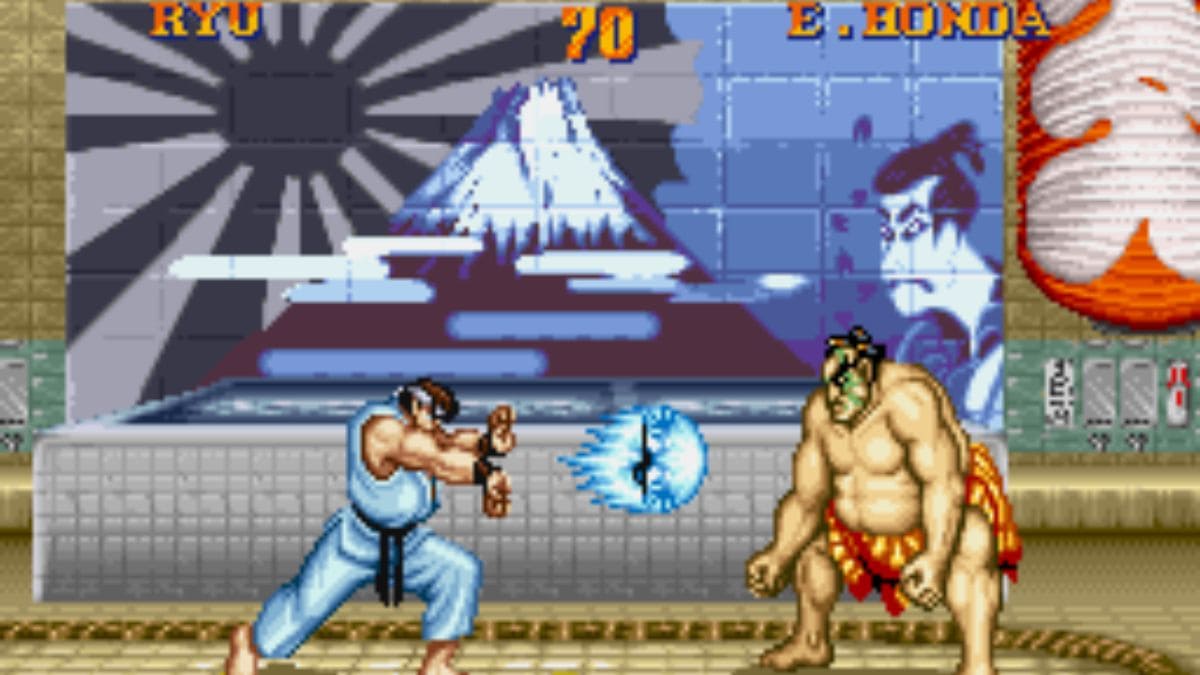
#4 Street Fighter II: Turbo (Arcade/SNES)
Every fighting game you love, Mortal Kombat, Tekken, Smash Bros, owes a blood debt to Street Fighter II. Arcades used to be for pinball and Pac-Man. Then this dropped, and suddenly every arcade smelled like pizza, sweat, and rage.
Turbo is the definitive version for most purists. It sped up the gameplay from the original (which felt a bit floaty), fixed the character balancing, and introduced the four “boss” characters playable for the first time.
The roster is legendary. Ryu, Ken, Chun-Li, Guile, Blanka, Zangief… these aren’t just characters; they are archetypes. Everybody had their guy. Did you mash buttons with E. Honda? Did you sit in a corner throwing fireballs? The skill ceiling is infinite. Learning to pull off a Dragon Punch motion (→↓↘ + Punch) for the first time felt like learning a secret language.
- Key Features: Six-button layout (Punch & Kick for Strong, Medium, and Fierce), iconic special moves (Hadouken, Sonic Boom, Spinning Bird Kick), and the competitive “Vs.” mode that ended friendships.
- Platforms: Arcade, SNES, Sega Genesis, Capcom Arcade Stadium (modern consoles), PC.
#5 Tetris (Game Boy)
You cannot talk about the best retro games without acknowledging Tetris. It is the simplest concept in the world: move falling blocks to make lines. And yet, almost 40 years later, we are still obsessed.
Specifically, the Game Boy version from 1989 is the one that history will remember. Why? Because it came packed in with the handheld. Suddenly, every kid on a road trip, every bored commuter, and every parent hiding in the bathroom had a little gray brick with a falling-block puzzle on it.
You know the feeling. When the music speeds up (that Russian folk song “Korobeiniki”), your heart starts pounding, the blocks are falling faster, and your brain goes into a flow state where you aren’t thinking, you’re just doing. It is the only game on this list that is proven to actually change your brain chemistry.
- Key Features: A, B, and Type-C modes, the iconic “Rocket” launch animation when you clear levels, and infinite replayability. You never “beat” Tetris. You just survive.
- Platforms: Literally everything. But the OG is Game Boy. Today, Tetris Effect is the modern king, but the retro charm is on the NES and Game Boy.
#6 Doom (1993 – PC)
We need to talk about Doom. If you only look at screenshots today, you’ll see chunky pixels and flat textures. But if you actually play Doom (which you should), you realize it is scarier than most modern horror games and faster than most modern shooters.
Doom isn’t about cover mechanics or reloading. Doom is about walking into a room full of demons, holding down the trigger on your shotgun, and strafing left like your life depends on it (because it does).
The level design is non-linear in the best way. You need keycards to open doors, but you also need to find secret walls. The game doesn’t hold your hand. Plus, the modding community is still alive 30 years later! People are still making Doom levels. It runs on everything from a smart fridge to a graphing calculator.
- Key Features: Brutal violence (for 1993), the BFG 9000 (Big Flippin’ Gun), ridiculously fast movement speed, and the ability to play deathmatch over a LAN cable.
- Platforms: PC (original DOS), SNES (bad port, sorry), Sega 32X (also bad), but modern re-releases on Switch, PS4, Xbox, and Mobile are excellent.
#7 Chrono Trigger (SNES)
Saving the best (or at least the prettiest) for last. Chrono Trigger is the magnum opus of 16-bit storytelling. It was a “Dream Team” collaboration between the creators of Final Fantasy and Dragon Quest, with character designs by Akira Toriyama (the Dragon Ball Z guy).
Most RPGs from the 90s are grindy. You have to fight random bats for two hours to afford a sword. Chrono Trigger said, “No, we hate that.” It has no random encounters. You see the enemies on the map, and you choose to fight them.
The New Game Plus mechanic was invented here. After you beat the game, you can replay it with all your levels and gear to find the sixteen different endings. Yes, sixteen. Depending on when you fight the final boss, the story changes. The time travel plot is coherent (which is rare), and the “Dual Tech” system, where characters combine their special moves, is still the coolest combat system in RPG history.
- Key Features: Beautiful sprite art, a soundtrack by Yasunori Mitsuda that will make you cry (especially “To Far Away Times”), zero filler content, and the character “Frog” (a knightly amphibian with a huge sword).
- Platforms: SNES, PlayStation (load times are rough), Nintendo DS (the best version?), PC (eventually fixed), iOS/Android, Switch, PS4, Xbox.
Conclusion
The best retro games on this list share a secret ingredient: Respect for the player’s time. They don’t have 40-hour tutorials. They don’t ask you to log in daily for a reward. They just hand you a controller (or keyboard) and say, “Good luck. Hope you figure out the boss pattern.”
They are tough but fair. They are pixelated but full of soul. Whether you’re revisiting A Link to the Past on your Switch or digging your old Genesis out of the attic to play Sonic 2, these games are still alive.
Which of these is your number one? Did we miss a hidden gem? Let us know in the comments.